How HealthPathways improves health outcomes for refugees
A suite of refugee pathways developed by the New Zealand HealthPathways team in partnership with Health New Zealand and the Ministry for Business and Innovation helps refugees receive the specialised healthcare they need.
Key insights:
- More consistent refugee healthcare – National pathways reduce variation and support GPs to deliver reliable care across a wide range of refugee health needs.
- Clear guidance for uncommon conditions – Clinicians are equipped to manage complex or rare issues not often seen in New Zealand general practice.
- Safer and more sensitive consultations – GPs are supported to address trauma, preventative care gaps, and culturally specific needs with appropriate sensitivity.
- Stronger support for primary care – Locum and rural clinicians gain accessible best practice advice and local service information, improving confidence in managing refugee health.
Specialised care, no matter where they settle in New Zealand
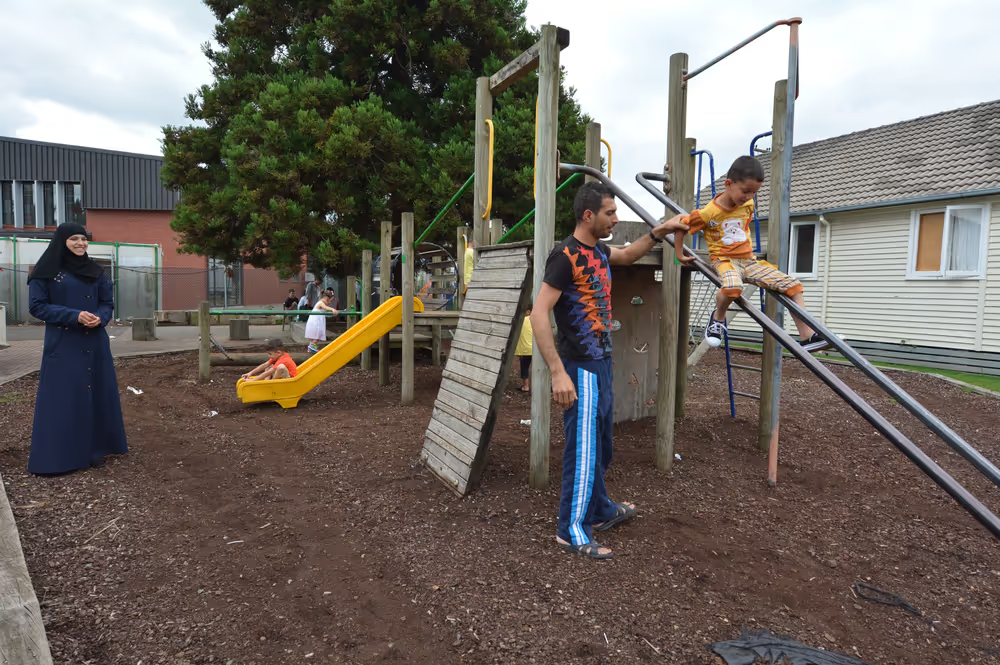
New Zealand is one of around 37 countries that take part in the UNHCR (the UN Refugee Agency) regular refugee resettlement programme. In 2020, New Zealand’s annual refugee quota was increased from 1000 to 1500.
All refugees arriving through the quota programme arrive in Auckland and spend at least five weeks at Te Āhuru Mōwai o Aotearoa, Immigration New Zealand’s Refugee Resettlement Centre. During their orientation, a Refugee Health Screening Service identifies and treats any personal health conditions before the refugees are settled in one of 13 locations around New Zealand. From this point, the expectation is that community GPs will provide ongoing health checks for them.
Dr Karen Chung, a clinical editor and GP at the Māngere Refugee Resettlement Centre, saw the need to create a support package and nationally consistent pathways that would help guide GPs through the particular health needs for refugees.
Dr Justine Lancaster, regional group clinical advisor and clinical lead for the Health New Zealand national pathways programme, facilitated this to become a nationally supported HealthPathways project
Screening for complex health issues
Often, refugees come with a background of complex health issues - many problems will have been untreated or unaddressed.
- Dr Justine Lancaster, clinical lead and project facilitator
Some refugees will arrive with post-traumatic stress disorder. Children may have incomplete immunisation or poor nutrition. They may have arrived from a place which has endemic parasites. They have increased risk from diseases like tuberculosis. Once they arrive, there are significant challenges navigating a new culture and a new complex health system while facing language barriers.
‘Part of the reason for screening refugees for health conditions on arrival is to minimise the infection risk to the rest of the New Zealand population,’ says Dr Lancaster, ‘But we also have a moral and ethical responsibility to care for the people we’ve welcomed into our society.’
Agreed best practice, with local variation
The refugee pathways were developed to align with the work being done by the Refugee Health Community of Practice working group to eliminate any unnecessary variation in care while also respecting the specifics of local health system services.
The pathways reflect agreed best practice for refugee health and are published with local variation to express specific information on services. Local details include where to get tests done, locally available funding and any support beyond the health system, such as refugee or local community support.
‘What that means for clinicians who use the pathways is that there is a standardised process for caring for the health of people who’ve arrived as refugees to support them over the first year or so, as well as key information about specific testing, screening, and needs they may have, with links to locally available resources and services,’ Dr Lancaster says.
‘We’re quite excited about the support this provides for stretched primary care providers, especially in rural areas where it can behard to attract GPs and practices may be staffed by a string of locums who may lack local system knowledge.’
The refugee pathways cover a range of health conditions from making sure patients are enrolled in bowel and breast screening programmes to checking that their sexual health needs are being met with appropriate screening.
‘There can be very specific needs depending on what’s happenedor the situation they find themselves in. They may need to be screened forfamily violence or may need mental health screening. They may needsupport for living with disabilities or there may be specific complex needsaround LGBTQi+ patients. And then there are very specific needs for certainpopulations, for example those that have experienced female genital mutilation.’
There might be malaria and oral health problems, limb amputations, braininjuries - it’s a very extensive list. So there are lots of very specific needsthat the pathways address for conditions that are not commonly encountered inNew Zealand. Especially for GPs who haven’t worked outside of New Zealand, theymay not be experienced or familiar with many of these conditions and so thepathways are designed to support them safely through consultations and remindthem to be particularly sensitive to the fact that these patients often havemissed preventative care opportunities and are playing catch-up.
- Dr Justine Lancaster, clinicallead and project facilitator
Want to explore how HealthPathways can support your health system? Get in touch.