
News
HealthPathways guidance now available through Heidi Evidence in Ontario
Read more

HealthPathways helps your teams agree on clear, local guidance. This creates smoother patient journeys, reduces variation, and helps the whole system work better for everyone.
Help them provide the best care, at the right time, consistently and efficiently with HealthPathways.
HealthPathways reduces workplace stress for health professionals, improves patient flow, and connects health teams for joined-up care.
of clinicians using Hospital HealthPathways at least once a week (Canterbury, NZ)
of GPs using Community HealthPathways weekly (North Cumbria, UK)
Agree it helps referrals (North Cumbria, UK)
say Hospital HealthPathways increases their efficiency as a doctor (Canterbury, NZ)
Help your health system effectively align primary and secondary care by enabling structured local collaboration that leads to clear, consistent care pathways.

Bring together hospital, community care providers and specialists around shared pathways.
Streamline processes to improve outcomes and free up system resources.
Build guidance that reflects your services, agreements and community realities.
Make it easier to deliver coordinated, efficient care across your network.
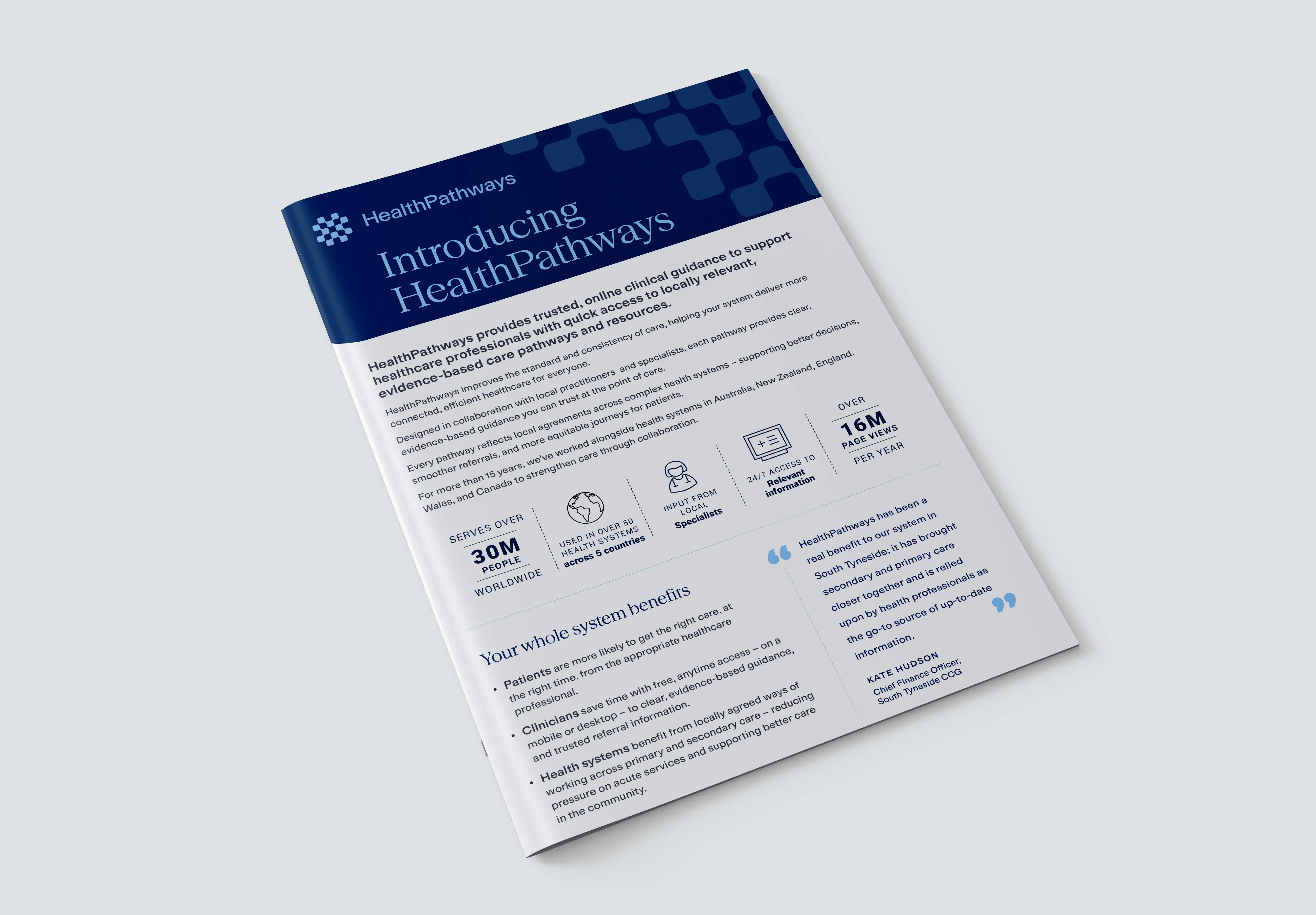
Download our brochure to learn more about how HealthPathways can support your health system.
HealthPathways helps your teams agree on clear, local guidance. This creates smoother patient journeys, reduces variation and helps the whole system work better for everyone.
HealthPathways enables structured local collaboration that leads to clear, consistent care pathways for use in your local health system.
HealthPathways provides a shared, locally approved source of guidance across primary, community, and hospital settings. This improves communication, aligns expectations, and supports smoother transitions of care.
Evaluations across multiple health systems show improvements in referral appropriateness, reduced acute admissions, faster access to services, improved patient navigation, and better alignment between providers.
A local clinical editor team works with GPs, specialists, allied health, and operational leaders to tailor pathways to reflect service configurations, eligibility criteria, workforce models, and health system priorities in your area.
Yes. HealthPathways is frequently adopted as a key enabler of integrated care. It strengthens shared decision-making, standardises clinical practice, and provides transparent guidance that supports new models of care.
Implementation can begin within weeks. Required resources typically include project management support, clinical editor capacity, governance structures, and participation from local clinical leaders.
By improving assessment accuracy, strengthening alternative care pathways, and reducing avoidable referrals or admissions, HealthPathways helps to shift care to the most appropriate setting and ease acute pressures.
Streamliners provides onboarding, training, implementation planning, communication materials, and coaching for clinical leaders to ensure strong engagement and sustainable adoption.
HealthPathways complements existing systems by acting as a centralised reference point that can be accessed through clinical portals, EHRs, or organisational intranets without requiring major technical integration.
Yes. We provide analytics tools, reporting dashboards, and evaluation support to help local HealthPathways teams understand pathway use, identify trends, and measure improvements over time.
Successful HealthPathways programme teams establish clinical governance groups involving primary care, hospital teams, and system leaders. These groups oversee priorities, approve content, and guide ongoing maintenance.
Absolutely. Every HealthPathways site is adapted to reflect local services, workforce models, specialist access, and regional priorities. Care pathways are adapted to local conditions by a team of clinicians and health system experts to reflect regional services, referral processes, and local models of care.